

First of all, welcome to the wonderful world of NRL Fantasy Football.
Maybe you stumbled upon the game on social media, were referred by a friend or colleague, or some other way, and we are glad to see you found the Amateurs and hope you enjoy our content.
If you are anything like us, this hobby will consume hours of your time every week from December to August between listening to podcasts, fussing about with trades, and watching more footy games than you ever have before.
Like any hobby, there are good and bad aspects to the game. We love the social aspect of the game, but we would by lying if we said we also don’t love the stats and trying to find every little edge. The best advice we can give is to seek out the good, avoid the bad, and have most of all have fun!
In this article, we will explain the basics, which will be enough to get you into the top (10,000) finishing teams. From there, you can move on to some more complex ideas, which will push you up into the the top 2,500 or so players, and finally into the “little edges”, which make our readers consistent top 1,000 finishers. If you played last year and struggled, and follow our advice, I guarantee this simple article will improve your experience dramatically.
A full set of rules written by the NRL can be found here, but we intend to pick out the important bits and simplify the game.
Lets begin.
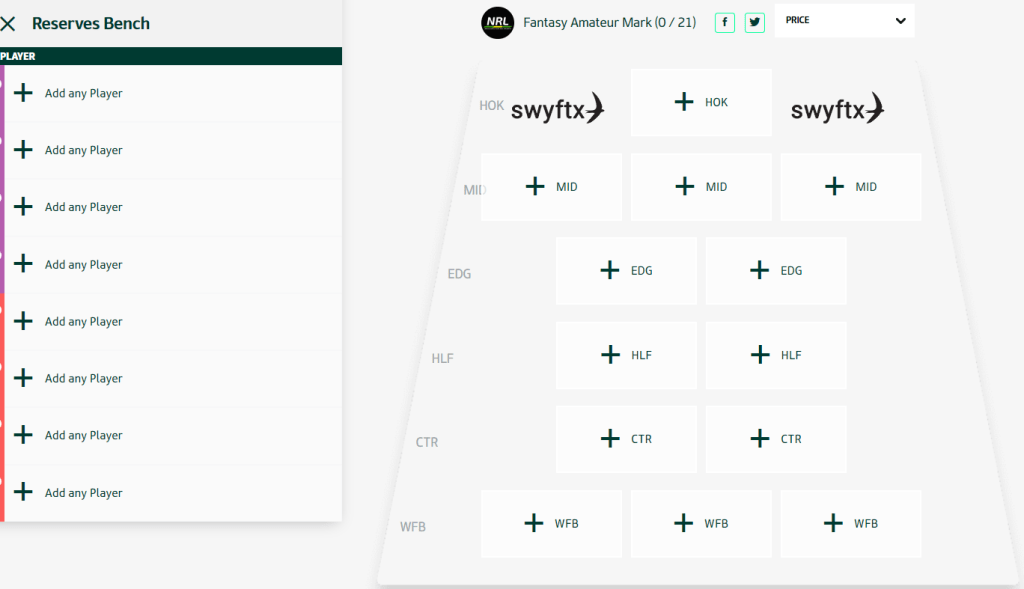
The basic idea with NRL Fantasy is to start with a salary cap of $10,00,000 that you use to build a squad of 21 players in an effort to score the most total points throughout the season. You are allowed to make 44 trades throughout the year: 2 per week for rounds 1-6, 3 per week for rounds 7-12, and 4 per week for rounds 13-27. There are only 36 total trades available in the first 19 rounds, before another 8 are added in round 20 to last you until round 27. This is to prevent players from using all their trades too early in the season.
26 NRL rounds and 44 trades means you get an average of 1.7 trades per week. It is important to use them wisely, which we explore later.
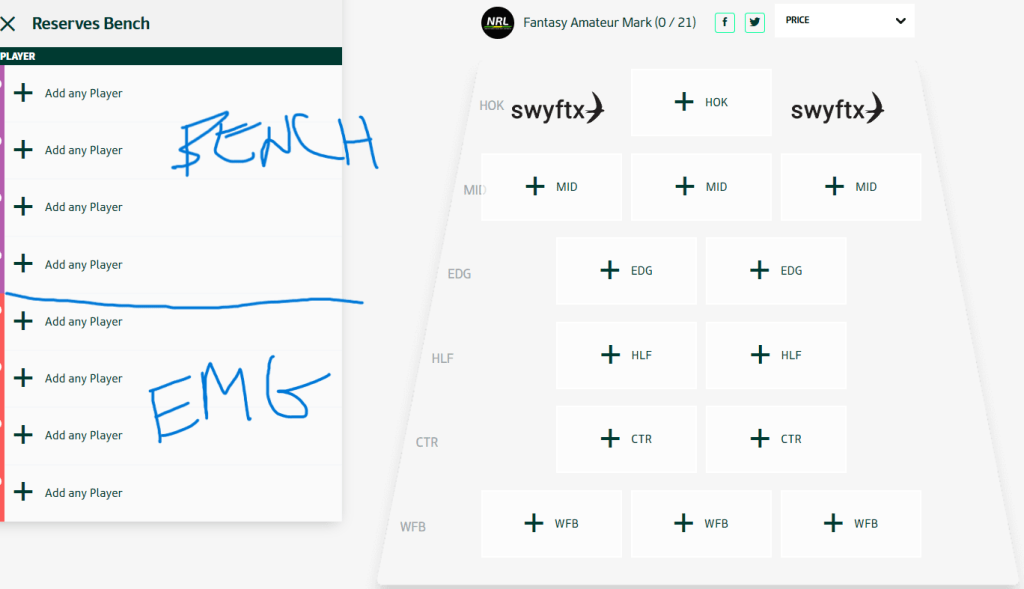
Players fill positions on the field, being hooker, middle, edge, half, centre and wing/fullback. Some players also cover multiple positions, which we call DPP or dual position players. Ideally you want a balance of all positions of players to ensure maximum injury cover. Your starting 13 players and 4 interchange players count towards your weekly score. Your 4 emergency players are non-scoring unless you have an injury, bye or suspension in your scoring 17. When you have a non player in your starting 13, they are replaced by the player on the reserves bench who is the highest on the list in that players position. When the non player is on the scoring bench, they are replaced by the first emergency, and so on.
The main function of the emergency spots other can cover for experienced players is cash generation. As a rule, your emergency list should contain 4 players that are under $300k, and your interchange bench should have at least 1 but ideally more of every single position.
You are also able to select a captain which will score double points, so be sure to select a top level scorer as your captain every week! You also pick a vice captain, who takes over as captain if your captain is ruled out.
THE SCORING
The scoring is formulated based on the in game NRL stats given to the NRL teams, which aren’t always perfect but usually pretty good.
| ACTION | POINTS |
| Try | 8 |
| Goal | 2 |
| Field Goal | 5 |
| Try Assist | 5 |
| Line Break | 4 |
| Line Break Assist | 2 |
| Tackle | 1 |
| Tackle Break | 2 |
| Missed Tackle | -2 |
| Offload (to player hand) | 4 |
| Offload (to ground) | 2 |
| Error | -2 |
| 40/20 or 20/40 | 4 |
| Metres Gained | 1 point per 10 metres* |
| Kick Metres | 1 point per 30 metres* |
| Penalty | -2 |
| 6 again infringement | -1 |
| Sin Bin | -5 |
| Send Off | -10 |
| Try Saving Tackle | 5 |
| Kick Diffusal | 1 |
| Forced Drop Out | 2 |
| Turnover (strip or tackle forcing knock on) | 4 |
| Escape in goal | 2 |
THE PRICING
An intimate knowledge of the pricing structure isn’t important, just the basic understanding will do for now.
The price each player starts at is based on their performance from the last season they played, which in most cases is the previous year. The exception to this is rookie players, which are all either $230k or $250k depending on if they played any games at all last year or just 1 or 2 games off the bench, and internationals, who are priced based on their performance overseas. There are also some discounts associated with limited games played, time out of the NRL, etc.
The price of the player is associated with their “break even” (“BE”), which is the score they would need to get in the next game to maintain their current price. From there, the prices work like the stock market. If the player performs better than the break even, price goes up. If the player performs worse than the break even, price goes down. Generally, the breakeven is approximately 1 in $13,800. So a player with a 40 point average = 40x$13,800 = $552k.
I suggest just paying the $19.95 for the “Coach” subscription so you don’t have to go looking for the BE on some other website. See below…
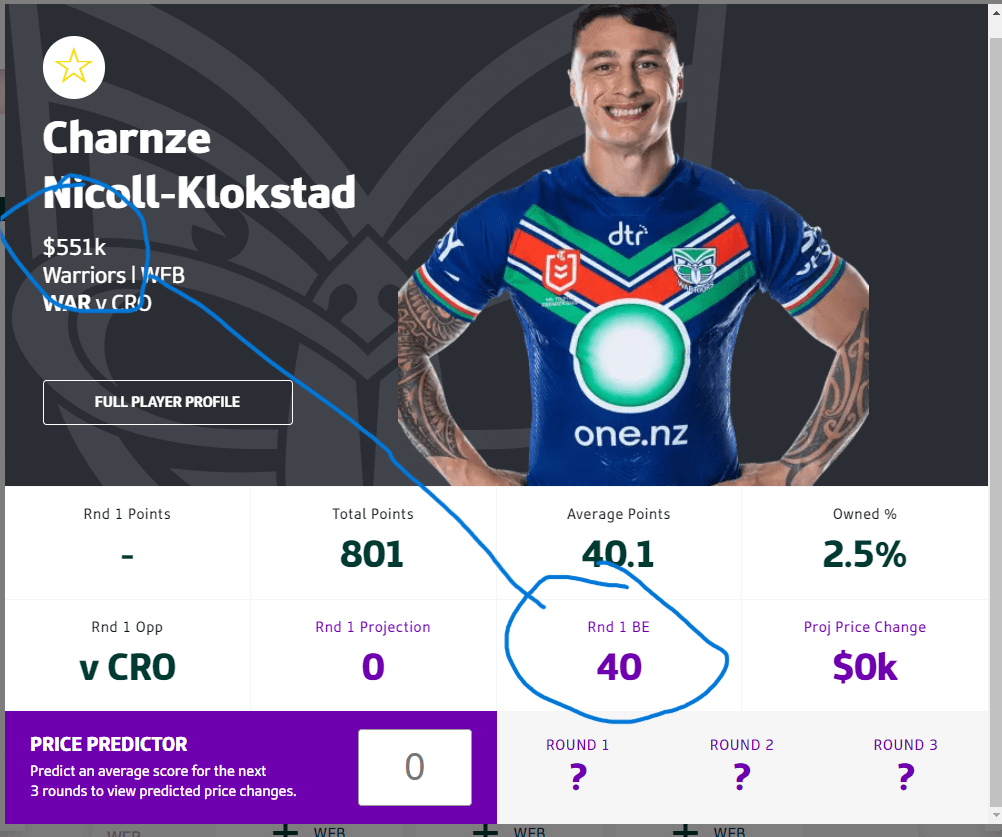
After round 1, the break even operates on a formula that is based on the players 5 game rolling average. Basically, it is along the lines of…
(4 most recent scores + Y) x $13,800 = current price x 5. Solve for Y.
Using the example above, a player that had scored 20, 37, 84, and 45 and was priced at $551k.
To solve BE:
$551k x 5 = $2,775,000
20 + 37 + 84 + 45 = 186
$2,775,000/$13,800 = approx 201
201 – 186 = 15, so that would be the players BE
If, in this situation, the player then scores say 65 points, beating their breakeven by 50, the price rise is usually about 50x$1350 = $67,500.
Once again, if you have the coach subscription, it does all the maths for you. I know some coaches don’t like it and use other sites, but I am lazy.
HOW TO SELECT A PLAYER
One of the major mistakes that new Fantasy coaches make is selecting players whose names are familiar, or who are “good footy players”. You might find a team like this in the hands of someone who hasn’t read this article…
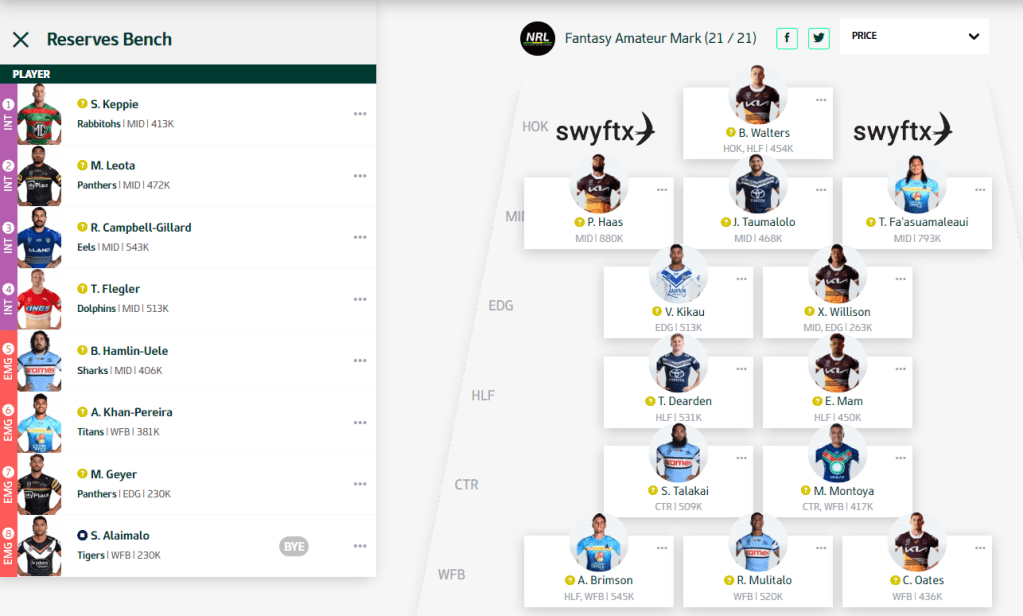
The mistake this player has made is essentially not following any sort of method or criteria for player selection. In short, we want the bulk of our selections to increase in value by at least $100k, if not $150k+. We simplify this by saying an 8-10+ point improvement on their starting break even.
So how do we find these players?
- Team changes where there is an opportunity for increased minutes, both on the incoming and outgoing teams.
- Team changes where there is an opportunity for a starting 80 minute position due to the departure or retiring of a player.
- Team changes where there is a significant shift in the responsibility of the players (e.g. more/less kicking, adding goal kicking, etc.).
- Players returning from one or more injuries in the previous year where they had game/s cut short.
- Players who underperformed last year due to a wide range of reasons, including returning from a significant injury, scoring less tries than normal, poor team performance, inconsistent role, etc.
Typically, there can be around 20-25 players in the preseason that might be identified as holding at least 8 points of value, all with various risk profiles.
If you are selecting a player who should average what we would call a “keeper level score” (i.e., you don’t need to trade them out, barring an injury) you can select players that hold less than 8 points of value. Due to the fact you never need to trade these players, the cash generation element is less important, so less value (cash making) is needed. Typically for these players we are looking for 4-5 points of value, but the higher the players average, the less important the gain in value.
Minimum average points required for a “keeper level score” by position:
Hooker: 50+
Middle: 55+
Edge: 50+
Half: 55+
Centre: 45+
Wing/Fullback: 55+
These are nominated by the approximate number of players at the position who score above these thresholds.
TEAM STRUCTURE
In terms of structure, we discuss it at length in our game theory article, but the basics are as follows…
5-6 potential keeper level scorers including an elite scoring captain a suitable vice captain (usually a relatively high, safe scorer)
At least 10-11 “cash cows” up to around $400k, prioritising high ownership, low risk and high upside, and if you can find more of these players you should get them.
Maximum of 4-5 mid range players $400k-$600k, prioritising high ownership, obvious value purchases, and limited downside.
Our suggestion for building your team is to start with a clean slate. You can use the sorting tool on the NRL Fantasy site to isolate players by price, along with a number of other criteria including team, ownership percentage, etc.
First select your captain, then try to identify as many cheaper players (under $400k) to select as possible based on the criteria discussed in the section earlier around identifying options. From there, identify the best potential keeper level scorers, and then select a couple of mid price guys to fill it out. If you find yourself unable to fit every player in that you want, our suggestion is to compromise on which mid range player you get, rather than compromising on your cash cows and guns.
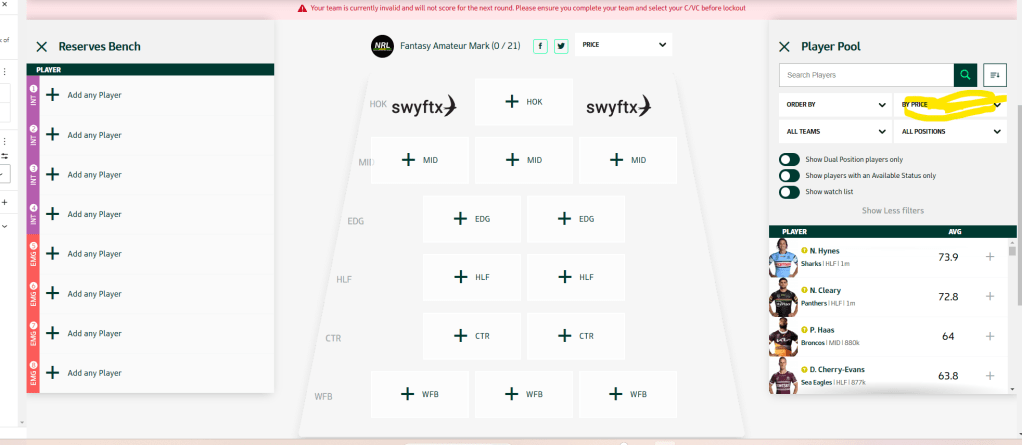
Remember, if you don’t think a forward is going to get AT LEAST 30 minutes, then it is highly unlikely they will score fast enough to meet the required thresholds. The outside backs the main issue is their work rate and tries.
If you want help, we have a team by team breakdown of projected minutes you can find here, and just look at the bottom of each of the team pages. We have a full team by team predicted 17 listed, with projected scoring, and small blurbs for all the players. These pages are constantly being updated with new information, so check them periodically to make sure you haven’t missed some news.
PLAYERS WITH HIGH OWNERSHIP
As a rule of thumb, players with high ownership are highly owned for a reason. Many new players want to go for players who are low ownership – which we refer to as a “point of difference” or POD. We discuss why PODs are overrated in our game theory article, but basically the gist is this…
If you have a player everyone else owns sucks, it doesn’t matter because we all have them so nobody is at a disadvantage.
If a player only you own sucks, it does matter because you likely missed out on a player everyone else has that is doing well.
Are we telling you to ONLY select guys with high (10%+) ownership? No. Are we asking you to critically evaluate your decision to go against the pack and understand the risk I mentioned above? Yes.
THE BYES
There are 7 teams that do not have a bye before State of Origin. Selecting a player from one of these 7 teams means you get the benefit of their score every week, plus the opportunity to maximise any cash making. This doesn’t mean to only select players from these teams, but you should try to target as many of them as you can that fit the other criteria.
THE SCHEDULE
A teams schedule does have an impact on a players scoring, but not always in the way you would expect. Weirdly, Cameron Munster scores much better against good teams than bad teams, where James Tedesco and Tom Trbojevic historically are much better against the bad teams.
As a rule, we would weight games against bad teams as better for attacking players and worse for guys who rack up the defensive workload, and vice versa. This should only be used to split two players, rather than as a baseline tool for player selection.
TEAM LISTS AND LAS VEGAS
Prior to the players playing their first game, you can trade them in and out as many times as you like. Once the first ball is kicked, your captain (double points) and vice captain (backup captain if the captain is ruled out) lock, along with any players in that game. The other slots are all still changeable.
With the opening two games being played in Vegas, we have a split round. This means on the Tuesday before the Vegas games, the team lists for those 4 teams will be announced. You should select all the players from these 4 games that meet your criteria to allow for maximum flexibility.
Then, the following Tuesday, after the first two games are played, the other 6 teams are announced. You should check your team and make updates based on unexpected team selections – which ALWAYS happen!
TRADING
After the completion of a round, and before the next round, you may complete your trades as mentioned earlier. It is important to use your trades with measure and purpose, which we discuss more in our game theory.
Basically, trades should be used to move on from players who will be injured for a significant portion of the season (we use 20%+ of remaining games as a rough guide, so early season it should be 4-5+ games), or their role/output is indefinitely different from your preseason predictions. It is important to not make decisions too hastily, using 1 or 2 game samples as the potential long term output, as this rarely ends up as the right decision.
For example, the #1 scoring player both in consistency and average for the last few seasons has been Nathan Cleary. Across the last 5 seasons, he has played 67 full games at an average of 72.3. While he averages 70+, he scores under 50 on 11% of occasions, and under 60 on 31% of occasions. In 2023, he opened the year with a 61 and a 37 before a bye in round 3, where many coaches expressed their… displeasure… at his scoring and sold him. He went on to average 86 over the 3 games after the bye, punishing those that sold him and making his 5 game average 71.2, almost exactly what he averages long term. Cleary is the best round 1 captaincy option indefinitely.
Moral of the story, pick the right players before round 1 and stick to your guns on players you have a clear data set on, and move on from players who are in a different role than you expected. Things like try scoring are not very predictable (for the most part), but over a large enough sample size everything ends up more or less where it should be. In short, buy in the slumps, and sell after the big gains!
GLOSSARY OF TERMS
There is a whole set of slang language used by the fantasy community. If you come across a term you do not understand please let us know and we can update the list below.
Cheapie/Cash Cow/Cashie – A player up to or around $400k who looks set to make a significant amount of price rises to be sold later.
Mid Ranger – A player who ranges between a Cash Cow and Keeper, traditionally the most high risk selection though typically provide a safer low end score than your cash cows and therefore more trustworthy on a weekly basis in your scoring 17 players. These guys may turn into the next category in the best instances.
Fringe Keeper/Keeper – A player who should score close to (within 2 points) or just over the minimum thresholds set out above for keeper level scoring.
Elite Keeper/Gun – A player who is comfortably above the keeper level thresholds. Stating the obvious, the more of these guys you can get by the end of the year, the better.
POD/Point of Difference – A player whose ownership is under 10%.
BE/Break Even – The score at which the players price remains even. If they score higher than their BE, the price goes up. If they score lower than their BE, the price goes down.
Trap – A player who may present at first glance some value, but does not meet the criteria for selection. May include players who massively overperformed in a small number of games.
PPM/Points Per Minute – The best way to track the scoring rates of players, which is the average amount of points they score per minute they are on the field. We use this tool to determine the value of forwards in particular. Typically, high a PPM is around 0.9 points per minute for a middle forward, and anything below 0.8 PPM is considered low. For edge forwards, anything over around 0.65 is considered high, with the elite players scoring at 0.7+. Anything below 0.55 would be considered low. For 80 minute players in the backline and spine this is tool is less relevant.
Loophole – The tactic of exploiting the emergency player system by intentionally putting a player you know will not play into your scoring 17, allowing you to basically have two bites at the cherry of picking which emergency score you want to use. For more on this, see the page.
DPP/Dual Position – A player that is eligible to be selected at multiple positions. Typically this mirrors their in game status. Players can have dual position (DPP) status awarded at specific times through the year if their role changes. The most common dual position eligibilities are WFB/CTR, CTR/EDG and MID/EDG, mirroring the real NRL where players float through the backline, between edge and centre, or between edge and middle.
Upside/Ceiling – The theoretical best case scenario for a player, either on a weekly basis or over a period of time. Just because two players are projected to average the same, it doesn’t mean that their theoretical best case scenario is the same. Issues that may effect a players upside or ceiling is their role in the team, the quality of the team overall, their schedule, etc.
Downside/Floor – The inverse of the previous item, it is the theoretical worst case for the player either on any given week or over a period of time. Typically we do not factor injury into a players floor, though if they have a repeated history of a specific injury such as a hamstring or concussion we may factor this into decision making given the relative predictability of it repeating.
Delete App – A common taunt when a player constructs a team that the community might deem to be non compliant with selection criteria.
TLT/Team List Tuesday – Team lists are announced every Tuesday at 4pm New South Wales time. We typically advise for players not to commit to trading until after team lists are announced to eliminate the risk of making trades that are neutralised by new information or team changes.
Rage Trade – When a player scores poorly on any given week, or maybe two or three weeks in a row, a lot of new (and experienced) players may feel the urge to impulsively trade a player out without fully considering whether this player may just be in a temporary low patch (see the Cleary example earlier). It is important to make intelligent decisions when trading.
Tonne Up – A player scoring 100 points in a week. This is very rare.
Points of Value – The number of points between the players projected average and their current price equivalent. To calculate the players equivalent price you just divide by $13,800. For example, a player who is $475k = 34.4 current price. To warrant selection, they would need to be projected to score at least 43 points per game from then onwards. Note, it is important to remember that a players past scoring is helpful data, but doesn’t help you until you buy them, so don’t use their season long average to calculate
CLOSING THOUGHTS
Once you have finished this article, you should now have a pretty solid grasp on the basics. If you want to elevate your knowledge to the next level, we recommend following all our social media channels – Facebook, Twitter/x, Instagram and Tiktok, and joining our 5000+ member Facebook group where there is constant discussions, news and player analysis being posted by some of the most intelligent fantasy minds in the business.
Over the preseason and throughout the year we do a full suite of podcasts, that can be found here, which cover a range of topics, including but not limited to:
- Team by team preseason previews
- An in depth look at the most highly owned players (studs and duds)
- Review of the performances in the trial matches
- Injury podcast with the NRL physio
- The weekly Tuesday TLT podcast
- The weekly Sunday wrap podcast
Additionally, the Amateurs offer a premium service for “good friends of the show”, where we publish game theory and strategy style articles, members only podcasts, in depth analysis for several key players, and more one-on-one discussions with the Amateurs creators. You can sign up here to elevate your game: https://buymeacoffee.com/fantasyamateurs/membership
Some of the members only podcasts you can expect to hear are:
- An in depth look at the best POD options (the PODcast)
- Game theory and team construction podcasts
- The weekly listener questions TLT podcast
Once you join, we suggest going through the team construction and game theory articles, checking out the team by team and individual player analysis, and trying to marry up these concepts as much as possible.
You don’t need to become a premium member in order to get a huge benefit from our community, so feel free to just take the free option and start there.
If you found this article helpful but don’t want to commit to a full fledged membership, feel free to buy us a beer at https://www.buymeacoffee.com/fantasyamateurs
Love you all.


 Amateurs Fantasy Sports
Leave a comment